Alton Towers

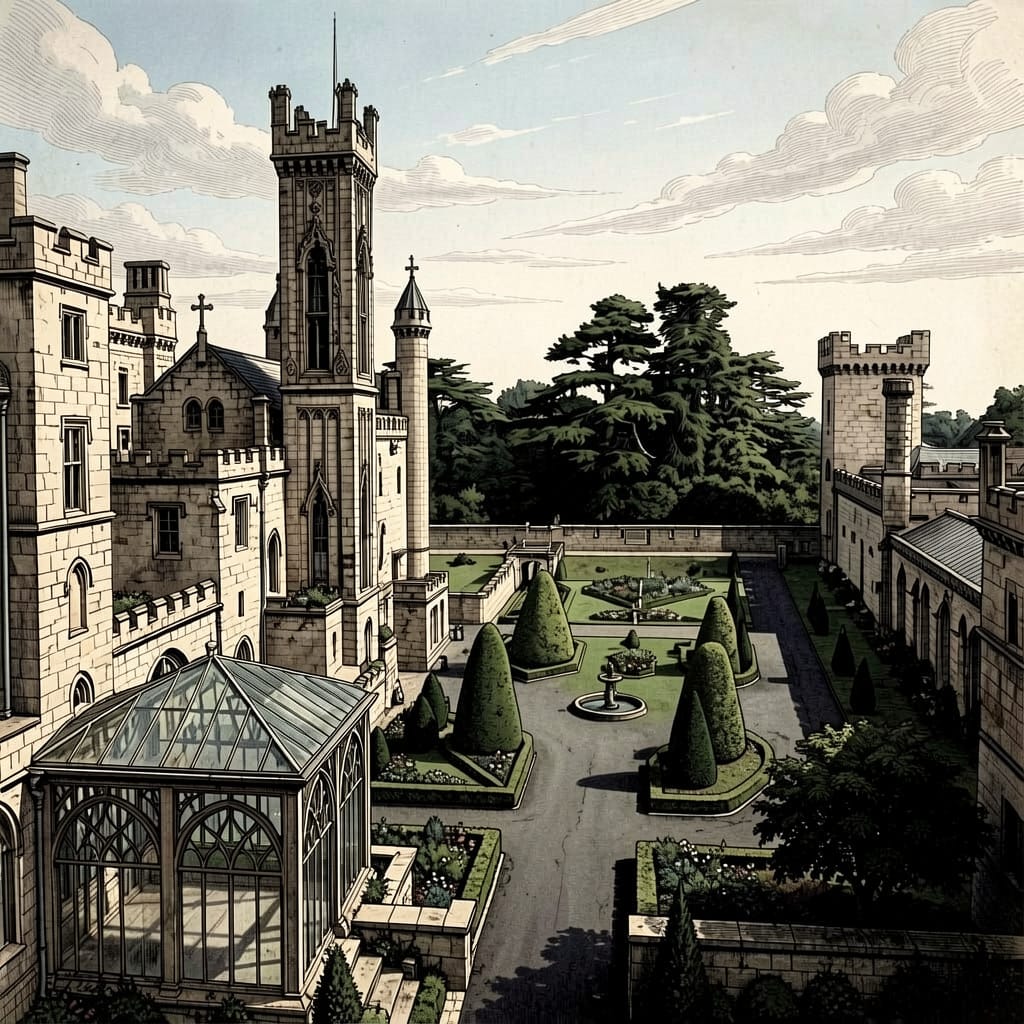
The Towers ruins, Alton Towers, Staffordshire

Location Profile
Type Theme park & former stately home
County Staffordshire
Original Owners The Talbot family, Earls of Shrewsbury (1412–1924)
Theme Park Opened 1980, billed as ‘England's first theme park’
Notable Ride Nemesis (1994)
First Appearance Cambion, Chapter Twenty-Two: Exits and Entrances

Alton Towers

Theme park and ruined stately home, Staffordshire.


Overview

Alton Towers is a theme park in the Staffordshire Moorlands, built around the ruins of a Gothic Revival stately home that was, for over five hundred years, the seat of the Talbot family, Earls of Shrewsbury. Billed as ‘England's first theme park’ on its 1980 opening, it has since grown into the largest theme park in the United Kingdom, though its most striking feature remains the roofless, ivy-softened shell of the house itself, still standing at the centre of the modern park.

The site's history stretches back much further than the Talbots: the ground was first fortified as an Iron Age hillfort, more than a thousand years before anyone raised a Gothic tower on it.


Geography & Atmosphere

The estate sits in the Staffordshire Moorlands, in the valley of the River Churnet, a setting the 15th Earl of Shrewsbury exploited deliberately when he laid out his gardens in the early nineteenth century. Long before any rollercoaster was built here, the valley below the house held one of the largest and most eccentric formal gardens in Britain: a Chinese-style Pagoda Fountain, built in 1831 and still capable of throwing water some ninety feet into the air; a thatched Swiss Cottage, originally built to house a blind Welsh harpist whom the Earl employed to fill the gardens with music; a Dutch garden, a copy of a Greek choragic monument, and glasshouses that once housed thousands of exotic plants across more than 13,000 newly planted trees. Much of this survives today, quietly overshadowed by the rides built around it.

Looking down Towers Street, the park's main thoroughfare, visitors are given a deliberately theatrical first view: the great lake and lawns, and beyond them the Towers ruins, gothic windows hollow and turrets softened by moss. The rest of the park spreads out from there into distinct themed lands — the alien-haunted Forbidden Valley, the industrial X-Sector, and various family and children's areas built up in stages since 1980 — so that the experience of walking through it is one of passing between quite different worlds every few hundred yards.

The Talbots & the Gothic House

The Talbot family, Earls of Shrewsbury, held the estate from 1412 to 1924. In 1801, Charles Talbot, 15th Earl of Shrewsbury, judged the old hunting lodge on the site beyond repair and began building a new Gothic Revival house in its place; his nephew John Talbot, the 16th Earl, completed the project over the following decades, working with the architect Augustus Welby Pugin, whose banqueting-hall bay window — roughly ten metres tall and six wide — remains the largest he ever designed for a private house. By the 1850s Alton Towers was among the largest privately owned houses in Europe.

The 18th Earl opened the grounds to the public in 1860, and by 1890 the gardens were drawing crowds of 30,000 to watch acrobats, lion tamers and firework displays; his successor, the 20th Earl, introduced regular summer fetes in the 1890s to keep pace with demand, even as he spent increasing amounts of time away at his other estate, having founded the Talbot Motor Car Company on the side. Escalating inheritance disputes and a changing financial climate led the family to sell off much of the estate from 1918, and the remaining house and grounds passed in 1924 to a group of local businessmen trading as Alton Towers Limited. The house was requisitioned by the War Office as an officer training unit during the Second World War, and the grounds reopened to the public in 1954; the house itself, by then beyond economical repair, was substantially demolished in 1951 and never rebuilt, leaving the roofless shell still standing today.


The Chained Oak

The grounds hold one of Staffordshire's most enduring ghost stories. Legend has it that John Talbot, 16th Earl of Shrewsbury, was travelling through the estate's woods one night in the late 1840s when an old beggar woman approached his carriage asking for money; when he refused and drove on, she cursed him — declaring that for every branch that fell from a particular oak tree, a member of his family would die. According to the story, a violent storm brought a branch down from the tree that same night, and the Earl himself died within the year. His descendants are said to have had the tree's remaining limbs bound in heavy iron chains soon after, in the hope of holding off the curse; the chained oak still stands in the grounds, its bindings rusted but intact.


Becoming a Theme Park

Alton Towers Limited's ownership of the grounds through the 1960s and 1970s gradually added a fairground, boating lake and chairlift to the existing gardens, but the site's transformation into a theme park proper began only in 1980, when property developer John Broome took over and installed the Corkscrew — the park's first major rollercoaster, and the ride still most associated with its early years. The Black Hole, an indoor coaster, followed in 1984, and the Tussauds Group's purchase of the park in 1990 brought a decade of rapid expansion: the walk-through Haunted House in 1992, and, in 1994, Nemesis — a £10 million ride built into an artificial gorge in the newly themed Forbidden Valley, its concept built around an alien creature disturbed and trapped beneath the ride's steel superstructure. By the time the Knight family visit in 1997, Alton Towers already has the shape it is still recognisable by today; ownership has since passed on twice more, first to Dubai International Capital in 2005 and then, in 2007, to Merlin Entertainments, which still runs the park.


Role in the Saga — Cambion spoilers Covers the second of three deliberate day trips in Chapter Twenty-Two.

Alton Towers is the second of the three trips Toby Knight arranges in Chapter Twenty-Two: Exits and Entrances, two weeks after Blackpool, in rain that returns as though it had never left. Ben runs through his checklist — tickets, sandwiches, waterproofs, extra socks, umbrella — “like a prayer he didn't believe in,” and repacks the same rucksack twice with the same careful stubbornness he uses to check the locks at home. The car park is churned mud by the time they arrive, and Robert's shoes fill with cold water before they have even reached the gate.

Offered Nemesis or the Haunted House first, Robert hesitates, then chooses the Haunted House — Toby reassures him there is no shame in it — and inside, jump-scare puppets set Ben's fist stiff on the rail, ready for a threat that never quite arrives. Buoyed by surviving it, they return to Nemesis; when the drop finally comes, it startles a laugh out of Ben — sharp, broken, and unfamiliar even to Robert, who has never heard that exact sound from him before, as though it had been kept somewhere for a long time and had nearly forgotten how to work. The Black Hole and the Corkscrew follow; on the Corkscrew's double inversion, Ben whoops with a rare, sudden joy that startles Toby into laughter of his own, as if he has briefly found his brother again inside the ride.

They cool down walking the gardens, peacocks dragging wet tails along the paths, while Ben instinctively scans every rise in the ground for a vantage point — a habit Toby gently mocks, needling that Ben would go looking for high ground in a Tesco. “It's a theme park, Ben. Stand down.” Ben, without turning round, answers simply: “I know what it is.” The day ends, as the Blackpool trip had, at a photo booth — Ben's arm over Robert's shoulder, Toby braced at his side, three faces not quite smiling on the print but close enough.


Trivia

  • Nemesis, opened in 1994 at a cost of £10 million, runs 716 metres through an artificial gorge at a top speed of 50 miles per hour, and remains one of the park's most celebrated rides more than thirty years on.
  • The Chained Oak still stands in the grounds today, its old iron bindings rusted but unbroken — whether from genuine caution or simple neglect, the story does not say.
  • The Towers house itself was never rebuilt after its partial demolition in 1951; the roofless ruin visitors see from Towers Street is substantially the same shell that has stood since.

Appearances

Title Role Notes
Cambion
Book One · Book of Thoth Saga
Day-trip setting The second of three deliberate excursions in Chapter Twenty-Two: Exits and Entrances, notable for one of the few moments Ben Knight is shown laughing freely.